Wednesday, October 2, 2013

Tesco Hudl tablet review: first look

Has the Tesco Hudl cracked the budget tablet conundrum once and for all?


Supermarkets and budget tablets have historically not been the best of matches, with the vast majority of such devices being made on the cheap by completely unknown brands and offering an appallingly sluggish and clunky experience.So, it’s perhaps understandable that I approached the Tesco Hudl with some trepidation. I was even more concerned when it showed up in a rather vivid blue hue, not too dissimilar to the colour used for Tesco’s own ‘Value’ product branding.
However, getting to grips with the Tesco Hudl slate immediately waylays such concerns, the build quality is surprisingly robust. The back panel sits nice and flush to the front fascia and is made from a soft-touch plastic with a matte finish which feels virtually identical to what Google uses on itsNexus 7 and Nexus 10 devices.  It feels very well made in the hand and there’s only a tiny bit of flex in the middle of the rear panel, not enough to be bothersome and everywhere else is solid.The edges are neatly contoured and offer good grip, although the bezel around the display is a little large. On the rear panel a camera port sits in the top right-hand corner while the “hudl” logo is displayed in silver text in the middle.The speaker grilles are a nice visual touch with one either side of the back panel towards the bottom, each being a set of three black strips with circular holes punched into them.
As well as the blue variant you can choose from red, black or purple colour options.Connectivity ports include a microUSB along the bottom edge, a 3.5mm audio jack and micro HDMI along the top. Meanwhile, along the right-hand edge there’s the power button and volume rocker towards the top, with a microSD slot immediately below.The onboard hardware and software is also a pleasant surprise. The Hudl runs Android 4.2.2 Jelly Bean in a stock configuration – the only tweaking Tesco has done is to add its own set of apps and widgets for accessing various services (Blinkbox, Blinkbox Music) and a small icon in the bottom left of the screen which brings up a kind of Tesco Hub, which includes access to Tesco Clubcard, Tesco Direct and Tesco Groceries.
Aside from this it’s a regular Android tablet with full Google certification and access to Google Play’s 700,000+ apps.Android Jelly Bean benefits from an expanded drop-down notifications menu, drop-down quick settings menu, the Google Now voice, search and location service and the Butter UI latency optimisations – which means moving between screens and menus is smooth and responsive.Performance at a glance seems to be none-too-shabby. I’ve noticed the occasional hiccup but nothing too serious and on the whole it’s really quite good. The processor is a quad-core Rockchip RK3188 clocked at 1.5GHz with a Mali-400MP graphics processing unit and 1GB of RAM.The display is decent enough, though understandably not the best due to the low price point. It’s a 7-inch LCD panel with a 1440x900 pixel resolution. That should mean a pixel density of around 242 pixels-per-inch (ppi) which sounds about right considering the screen is reasonable in terms of sharpness. Colour is quite punchy, contrast is not bad, but brightness feels like it’s lacking a wee bit. It's quite reflective and smudgy while viewing angles are poor.For storage you’ve got 16GB onboard and the microSD slot supports cards up to 32GB. Other key features include dual-band Wi-Fi, Bluetooth 4.0 and battery which Tesco says will last nine hours.
Considering the £119 price point this seems like a device which is very good value for money as it offers a decent stock Android experience. When you add to that the fact that Tesco Clubcard vouchers can further reduce the price to lower than £100 and it’s starting to look like an absolute steal.

Sunday, September 22, 2013

Moto X review: The biggest "M" in tech is back


Pros:  
Moto Maker customisation choices are radiant, magnificent raise quality, splendid programming, beautiful looking gadget, Google Now gets another rent of existence with Touchless Control, incredible electric cell life 

Cons:  
Specs could be better for the value, no expandable space, not accessible in the UK (Boo!) 

Verdict:  
Motorola is authoritatively back – this handset is massive. Yes, the specs could be better and we're chafed by it not getting a UK discharge date yet assuming that this is an indication of what's to come holds, things are unquestionably searching up for one of tech's most senior marks.   


The Moto X comes charged as a point of interest telephone for Motorola – the handset tipped to rebrand Motorola's name in an industry that, generally, has disregarded all around the range of one of its eldest marks. 

While a long way from the first cell phone that Motorola has discharged since its securing by Google, the Moto X is the first where you truly feel the new manager's impact, especially on the programming and client interface side of things. 

Given this essentialness, its a bit of astounding – and unsettling, legitimately – that the handset isn't going to the UK (what does this choice say about Motorola's goals for the non-North American market?). In any case, we felt it was deserving of a definite survey, so read on for our contemplations on the handset that is convey the banner for Motorola's resurgence as a top level versatile creator. 

Moto X survey: Design 


The Moto X is produced out of plastic and Kevlar, and it feels incredible in the hand – the pictures truly don't do this handset equity. The two-piece form development is vigorous, and it doesn't feel like a defensive case is completely indispensible, which isn't something one can say about generally high-end handsets. 

It's agreeable in the hand excessively, because of the bended back and the telephone's general smallness. The screen (secured in extreme Gorilla Glass) runs practically edge-to-edge on the front, making the telephone marginally more modest than generally 4.7-inch handsets. It's 10.4mm thick and 130g in weight, which is about normal by current models. 

Purchase the telephone in-store and you have a decision between white or dark fulfills, however head over to the Moto Maker site and you can customise the outline to a bewildering degree: there are two front colours, 18 back colours and seven stress colours to look over, and additionally the choice to have a personalised message printed on the back, and the decision of either 16gb or 32gb of space (the in-store variant is 16gb just, with no card for extension). 

The telephone will then be made in Motorola's US processing plant and delivered to you in four days or less. 

Moto X audit: Screen 

Motorola has devised a workable plan to practice restriction with regards to the screen, selecting a 4.7-inch AMOLED with 1280 x 720 pixels. It's not the most amazing or most honed showcase available, however in every day utilize you're unrealistic to feel short-adapted. 

The AMOLED tech conveys a rich, exceedingly immersed picture that is perceptibly hotter than, say, the LCD screen on the also measured Google Nexus 4. Some may incline toward the cooler tones of a LCD, however films, photographs and amusements all look out of this world vibrant here. 

Moto X survey: User interface 

The X doesn't utilize the local Android client interface as seen on the Nexus 4, yet unlike Samsung, HTC and LG, Motorola hasn't given the entire thing a colossal (and basically unnecessary) update. Truth be told from the get go look, you may think the telephone's Android Jelly Bean 4.2.2 OS hasn't been touched whatsoever – however updates, however unobtrusive, are there, basically as restrictive applications and administrations. 

Dynamic Display, for example, flaunts warnings and the clock indeed, when the telephone is snoozing, by blurring them lock stock and done occasionally on the screen. It's so low force that electric storage device life is practically unaffected, and does go a little way towards controling impulsive telephone checking. 

Motorola Connect gives you a chance to send and gain writings and accept calls from your PC (at no additional expense) through a Chrome web browser growth, while Motorola Migrate permits you to remotely exchange photographs, films, call and content history, and SIM contacts from any Android telephone. 

The most amazing UI quill in the Moto X's top, in any case, is Touchless Control, which basically takes Google Now's voice collaborator and makes it accessible to you, without hands 24/7. Simply say, "OK, Google Now," and it'll begin listening to whatever address or summon you have. 

It strikes us as additional exact, successful and regular than Apple's Siri, and the truth you can utilize it without needing to lift a finger, not even to carry the X out of rest, is truly stunning. 

Moto X audit: Performance 

Contrasted with quad-center Android powerhouses as the HTC One, LG G2 and Samsung Galaxy S4, the Moto X may appear a tad baffling: its progressively on a standard with the Nexus 4, Galaxy S3 and Sony Xperia Z. Anyway while its double center Qualcomm Snapdragon S4 Pro CPU isn't pushing any verges, its more than able enough of managing any application or amusement you may toss at it. In a year or two that may change. Anyway for the time being its fine. 

A more huge burden could be the absence of space. On our 16gb variant, 4gb of space was now brought up with crucial programming and the OS. You do get 50gb of distributed storage through Google Drive, however that is not exactly the same as ready for. 

The 2200mah electric cell is a highlight, giving around 13 hours of talk time in our tests. 

Moto X audit: Camera 

The Moto X's 10-megapixel principle Polaroid has reasonably expansive pixels, giving marginally preferable low light execution over a few opponents, however we every now and again discovered photographs to be only exceptional as opposed to dazing. Colour generation can appear to be a little dull on occasion. There's additionally 1080p movie and the alternative to shoot 120fps moderate movement footage. 

The Polaroid programming is an alternate territory where Motorola has endeavored to make things more client ami

Saturday, September 21, 2013

iPad 5: Everything we think we know about the specs, release date, and price of the next iPad


The iPhone 5S is out! What's next? The 5th generation iPad of course.
It is highly likely a new iPad will be unveiled by Apple in mid-October. The fourth-generation iPad was first shown at an event in October 2012, a few weeks after the iPhone 5's unveiling, andrumors point to a repeat of Apple's 2012 late-game shenanigans.

What we know

Officially? Nothing. Apple hasn't said one word about its next iteration of the full-size iPad.

What we think know

When will it will be announced?
Rumors currently point to an October 15 event.
Its case design
According to pictures posted by Sonny Dickson, the fifth-generation iPad isn't too dissimilar from the current design of the iPad Mini. The case is narrower than the iPad 4, has thinner bezels, with more-rounded edges, and according to KGI Securities analyst Mingchi Kuo, it's said to be about 15 percent thinner and 25 percent lighter than the iPad 4.
While the rumored case design wouldn't be a radical change, it would address a few annoyances about the iPad 4's look and feel. Namely, its much too sharp edges, wide width, and body corpulence. A more-rounded iPad 5 could mean an iPad 5 that's much more comfortable to hold.
It won't be larger than 9.7 inches
Although Apple is reportedly testing larger screen sizes -- up to 13 inches -- for future versions of the iPad, it would appear that we wouldn't see a release of a larger iPad until 2014 at the earliest.
It won't be any more or less expensive
With the iPhone 5S, Apple kept its normal pricing structure -- a $199 starting price for the subsidized model -- and if pricing history is anything to go by, the base-level 16GB Wi-Fi-only iPad 5 will start at $499.

When can we expect a release?
Probably early November, same as last year.

What we want to see

Much of my iPad wish list was covered above, but here are a few more things I'd love to see Apple throw in for good measure. Just to be clear, a fingerprint scanner on the iPad isn't something I'm particularly excited about.
An upgraded A7 (A7X) processor
The iPhone 5S' A7 is a powerful piece of silicon, but if history is anything to go by it will pale in comparison to the iPad 5's expected A7X. With a larger higher-resolution screen, the iPad 5's GPU has more pixels to render, which means more work and a higher bandwidth requirement.
So, don't be surprised if we see a few extra GPU cores in the A7X.
A better camera
Look, much to my embarrassment, people still use their iPads to take pictures in the exact manner as they would their smartphones. It's not going to stop, so Apple might as well lean into it and give these budding awkward-looking photographers something to get excited about.
Hopefully, the iPad 5's camera receives the bulk of upgrades from the iPhone 5S, including slow-mo, improved low-light exposure, and some "True Tone" action for more-balanced flash.
Longer battery life or faster charging
As demand for a thinner lighter iPad increases, so does the difficulty in fitting a larger longer-lasting battery in its casing. Apple gave the iPhone 5S only a slight bump in battery life over the iPhone 5, so I'm keeping my iPad 5 battery life improvement expectations low.
However, let's not overlook the importance of charging speed. Right now it takes several hours to charge an iPad 4 from 0 percent to full capacity. I'd love to see this time receive a significant cutting.

The iPhone 5C and the youth factor


Apple's iPhone 5C has suffered from a case of mistaken identity.
When leaks about the iPhone 5C started showing up earlier this year, tech industry observers started speculating that this was the long-conjectured "iPhone Mini." Those expectations were based solely on the previous success of the iPod Mini, which was smaller and less expensive than Apple's flagship iPod and went onto become the best-selling model in the product line.
The timing was perfect for such a product, the tech industry surmised, because Apple has been losing market share in emerging markets to sub-$300 Android devices. When Apple officiallyunveiled the iPhone 5C on Tuesday, it was not that device. It started at $99 on contract and over $500 without a contract. As such, the tech press and market analysts frowned. (Some actually sneered.)
However, evaluating Apple is a yin-and-yang thing. You have to look just as closely at what the company doesn't say and doesn't do because it says so little and is extremely calculating with every product decision since it releases so few products.
If you want to understand what Apple's doing with the iPhone 5C and why it could make sense, here are the two factors to think about:
1. Apple did not release a new iPod Touch
One of the regular features of Apple's annual September product event is the release of new iPods. It didn't happen this year. While Apple continues selling last year's iPod models (they are still available in the online store and at retail stores), the product is quickly reaching end-of-life.
In July, Apple reported in its earnings call that the number of iPod units sold was down 32 percent year over year, one of the largest dips in the history of the product line. That's significant because the iPod Touch has continued to be a strong seller during the past several years. As recently as 2011, there were quarters when iPod Touch sales rivaled iPad sales.
The iPod Touch was extremely popular among children and teens, who could use it to enjoy the benefits of iPhone apps over Wi-Fi. Apple sold more than 80 million iPod Touch devices from 2007 to the end of 2012. (During that same period, it sold 244 million iPhones, by comparison.)
While the entry-level iPod Touch never cost less than $199 -- the same price as the entry-level iPhone on a two-year wireless contract -- the appeal was that you didn't have to pay $70 per month for a smartphone contract with a data plan like you did with an iPhone. However, the economics of smartphones have changed drastically over the past 12 months.

Saturday, September 14, 2013

LG G2 may launch in India soon, company posts teaser on Facebook page

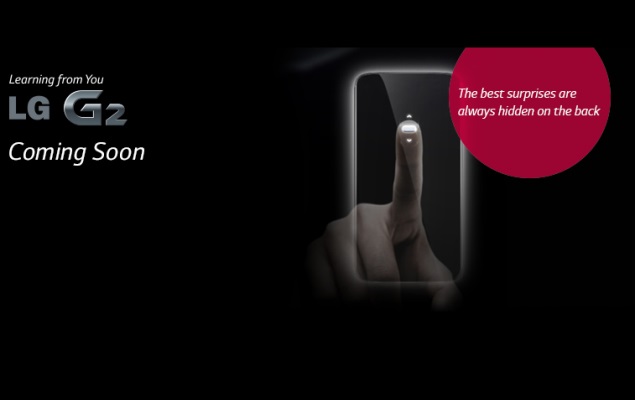
LG India has posted an image on its Facebook page to tease its new flagship smartphone, the LG G2which is expected to be launched soon in India.
LG-G2-india-teaser-big.jpgThe teaser image does not reveal anything new and comes with the taglines 'Learning from You LG G2 Coming Soon' and 'The best surprises are always hidden on the back'. Barring the teaser image there is no official word yet on the LG G2's India launch.
The South Korean electronics major seems to be doing its bit to generate interest in the Indian market by teasing its flagship smartphone that launched globally last month.
Recently, the company announced that the LG G2 was ready for a global roll out. The phone was recently launched in the United States and Germany. The LG G2 was initially released in South Korea.
For those unaware, the LG G2 comes with a 5.2-inch full-HD (1080x1920 pixels) display with a pixel density of 423 pixels-per-inch (ppi). It is powered by Qualcomm's quad-core Snapdragon 800 processor clocked at 2.26GHz. The device comes with 2GB RAM and offers 16GB and 32GB storage options. The LG G2 sports a 13.0-megapixel rear camera with Optical Image Stabilisation (OIS) and a 2.1-megapixel front shooter. The phone runs Android Jelly Bean 4.2.2 and is powered by a 3,000mAh battery. The LG G2 also comes with software features like Answer Me, Plug & Pop, Text Link, Slide Aside, and a Guest Mode.
LG G2 key specifications
  • 5.2-inch full-HD display
  • 2.26GHz quad-core Qualcomm Snapdragon 800 processor
  • 2GB RAM
  • 16GB/ 32GB internal storage
  • 13.0-megapixel rear camera
  • 2.1-megapixel front camera
  • Android 4.2.2 Jelly Bean
  • 138.5 x 70.9 x 8.9mm
  • 3,000mAh battery